Last updated October 31, 2026
 House lockouts
 Re-keying
 Deadbolt upgrades
 Smart locks
 Schlage
 Kwikset
 Car keys & fobs
Non-destructive entry first, always - and we re-key Schlage, Kwikset, and Baldwin locks on the spot while you watch
You get a price before we start. It does not change when we arrive. No surprises.
Get your free estimateCar Key Replacement Maintenance Checklist for Torrance Homeowners
Your front door lock gets the respect. Your car key gets ignored until you’re standing in a parking lot at the Del Amo Fashion Center holding a dead fob and wondering what a tow truck costs these days. Here’s the uncomfortable truth: modern transponder keys and proximity fobs wear down on a quiet schedule, and Torrance’s salt air plus UV exposure pushes that schedule forward faster than drivers in Redondo Beach or Palos Verdes realize. This guide lays out a year-round maintenance routine you can do at home, what fails first, what it costs to fix when you catch it versus when you don’t, and when to stop troubleshooting and call a locksmith who does Car Key Replacement in Torrance every day.
Styles & brands we work with
Quick Answer
A Torrance homeowner’s car key maintenance checklist should cover four things every six to twelve months: testing fob battery voltage, checking for transponder signal degradation, inspecting the physical key blade for wear, and feeling for ignition cylinder resistance. Catching a weakening fob battery early costs about $60 for a locksmith replacement versus $400-plus for a full key replacement and programming once the transponder fries or the ignition cylinder damages the blade. Most failures are preventable if you know what to look for.
Table of Contents
- Why Car Keys Fail Faster in Torrance
- The Annual Car Key Maintenance Checklist
- Monthly Quick Checks That Take 60 Seconds
- Dealer vs. Locksmith Key Replacement: What Torrance Drivers Should Know
- Is It the Key or the Ignition Cylinder?
- Most Common Key Failure Patterns in Torrance Vehicles
- What Key Replacement Actually Costs in Torrance
- Common Mistakes to Avoid
- When to Call a Professional
- Frequently Asked Questions
- The Bottom Line
Why Car Keys Fail Faster in Torrance
Torrance sits close enough to the Pacific that the morning marine layer does more than cool your house. It deposits a fine salt film on everything, including the rubber membrane around your key fob buttons. That membrane is the only thing standing between the internal circuit board and moisture. Once micro-cracks form, humidity creeps in, the board oxidizes, and the fob starts behaving erratically. Sometimes the lock button works from three feet. Sometimes it doesn’t work at all. Then it works again, which is the most dangerous phase because it feels like a fluke and not a pending failure.
The UV load matters too. Torrance averages over 270 sunny days a year. The combination of salt air and UV degrades the soft-touch coating and button seals on key fobs faster than inland areas like Riverside or San Bernardino. We’ve replaced keys for South Bay drivers that looked sandblasted after four years, while the same generation key from an inland vehicle looked nearly new. The plastic isn’t the problem; the seal is. And the seal is what protects the electronics.
The third factor is usage pattern. Torrance homeowners run fleets of errands. School drop-offs, grocery runs at the Torrance Farmers Market, commutes to aerospace employers along the 405 corridor. Every button press is a cycle on the battery and the contact pads. Every key turn is wear on the brass blade and the wafer pins inside the ignition cylinder. People treat the key like furniture instead of a consumable component. It’s not. It’s a mechanical and electronic device with a predictable service life.
The Annual Car Key Maintenance Checklist
Run through this list twice a year, or at minimum every spring and fall. It takes about twenty minutes total and catches most failures before they strand you. If you have two vehicles, double the time but not the effort, because after the first one you’ll know what you’re doing. For exact pricing on any replacement that comes up, call Tumbler Lock & Key at (877) 265-3856 and get a quote before you spend anything.
- Test the fob battery with a multimeter. A healthy 3V coin cell (usually CR2032 or CR2025) reads between 2.9V and 3.1V when measured under load. At 2.7V or below, the fob loses range first, then fails entirely. Battery replacement is the cheapest car key service we do, and Torrance drivers consistently wait too long. The battery is not the expensive part. Waiting until it leaks inside the fob is.
- Check transponder signal strength. For proximity keys (the ones that unlock when you touch the door handle), stand ten feet from the vehicle with the key in a normal pocket position. If the car doesn’t detect the key until you’re standing next to the door, the signal is weakening. A healthy fob reads from at least 5-8 feet indoors and 10-15 feet in open air. Signal degradation is progressive. It’s not a switch; it’s a dimmer.
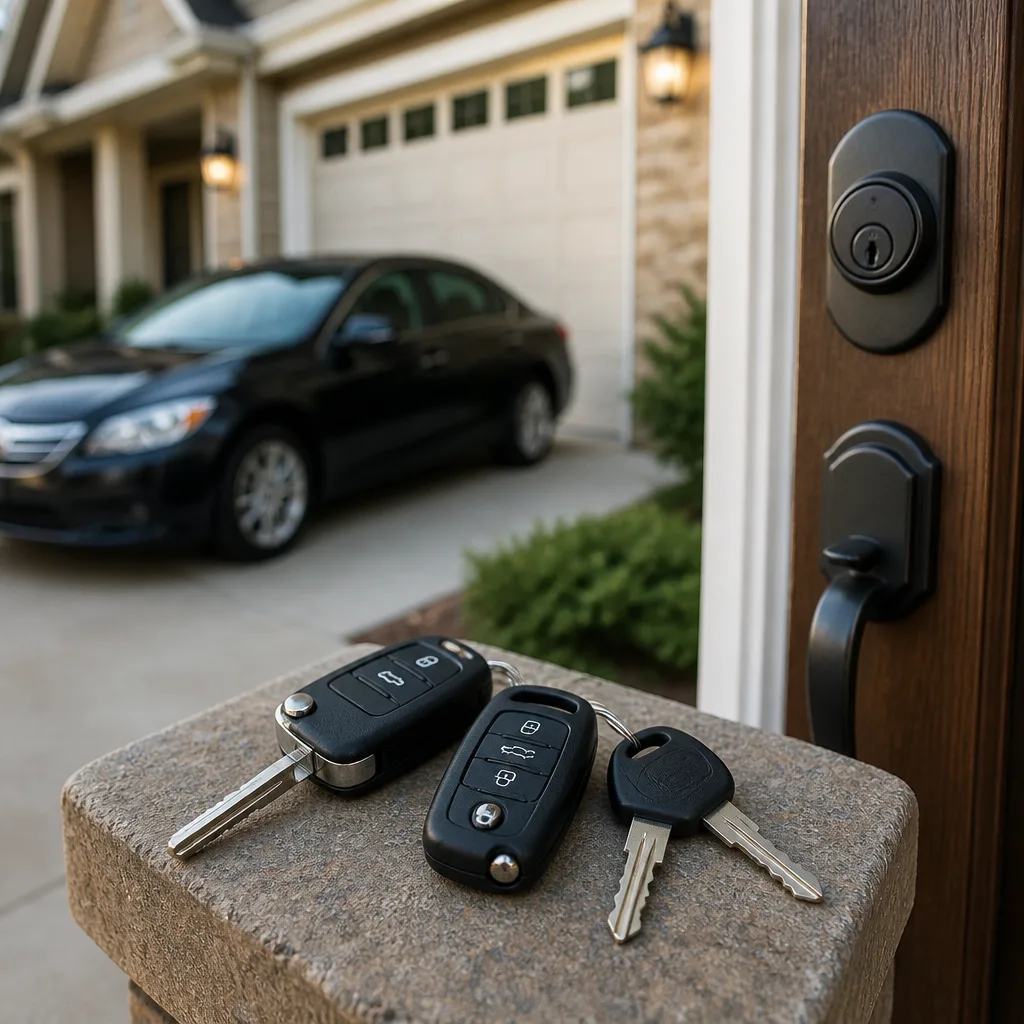
- Inspect the physical key blade for visible wear. Pull the emergency blade out if you have a flip key or pull-apart fob. Look at the cuts. The sharp peaks should be defined, not rounded. Hold the blade at an angle and look for daylight wearing on the brass. A worn blade puts extra torque on the ignition cylinder pins, which spreads the wear to a more expensive component. If the blade looks like a used butter knife, replace the key before the ignition cylinder becomes the casualty.
- Turn the key slowly through all four ignition positions. Resist the urge to do this while parked in the driveway with the engine off. Feel for any grinding, sticking, or points where the cylinder binds. The key should rotate smoothly through accessory, on, start, and back. If there’s a notch or a catch, note which position it happens in. A catch between accessory and on usually means wafer pin wear. A catch at the start position often means cylinder issues.
- Check the emergency blade deployment mechanism. If you have a spring-loaded flip key, the hinge and the release button are wear points. Test that the blade snaps out fully and locks into position with a crisp click, and that it doesn’t wiggle at the base when deployed. A floppy flip key is an early warning that the hinge spring is failing, and the key will eventually fail to stay extended in the ignition.
- Clean the fob contacts with isopropyl alcohol. Pop the key open along the seam. Use a cotton swab with 90% isopropyl alcohol to gently clean the contact pads where the buttons press against the circuit board. Salt air from Torrance’s marine layer leaves a film that increases electrical resistance. Clean contacts mean better button response and more consistent signal transmission.
Monthly Quick Checks That Take 60 Seconds
You don’t need a full inspection every month. Do these two things on the first of each month, or set a calendar reminder. It’s the difference between catching a problem at $60 and catching it at $400.
- Range test with fresh posture. Stand in the same spot in your driveway and press the lock button. If the car doesn’t respond from where it normally responds, the battery is fading or the seal is compromised. Compare against last month’s baseline, not against an absolute distance.
- Visual inspection of the rubber seal around the buttons. Look for shrinking, peeling, cracks, or a rough texture where there used to be smooth rubber. In Torrance’s salt-plus-sun environment, the seal is the first thing to go. Once the seal fails, moisture gets to the board and the clock really starts ticking.
- Listen for strange key chatter. When you insert the key into the ignition, there should be no plastic-on-metal scratching noise. A dry, gritty insertion sound means the blade is worn or the cylinder needs lubrication (specifically a dry graphite lubricant, not WD-40).
Dealer vs. Locksmith Key Replacement: What Torrance Drivers Should Know
The reflex for most Torrance drivers is to call the dealer. Dealerships are familiar, they’re often close, and the service advisor sounds confident. But for car key replacement, the dealer is rarely the fastest or cheapest option. And for many vehicles, they’re not even the most capable, because a dealer’s parts counter is tied to one brand while a locksmith’s key programming tool covers dozens.
A dealer replacement for a modern transponder key in the Torrance area typically runs $200 to $500 depending on make and model, plus a towing charge if the vehicle can’t be driven. Wait times run from one to three business days for the key to arrive, plus service appointment scheduling. Many Torrance dealerships are booking service appointments a week out or more.
A locksmith doing car key replacement in Torrance typically charges $120 to $350 for the same key cut, programmed, and verified on-site. The difference is that a locksmith comes to the vehicle with the key blank, the cutting equipment, and the programming tool in the van. Most replacements are done in 30 to 60 minutes in your driveway or parking lot. No tow truck, no service writer, no waiting for a parts department to order a blank from a warehouse.
When does the dealer make sense? Rarely. If the vehicle is under warranty and the key failure is a manufacturing defect, the dealer handles it at no cost. If your vehicle uses a newer encrypted key system that only the manufacturer’s proprietary diagnostic tool can program (this is true on some 2021-plus European models), a dealer may be the only option for now. For the vast majority of Hondas, Toyotas, Fords, Chevys, Nissans, and Hyundais that dominate Torrance driveways, an automotive locksmith handles everything the dealer does, faster, at the vehicle, for less.
At Tumbler Lock & Key home, we work with the full range of key types: basic transponder keys, proximity smart keys, push-to-start fobs, and the physical emergency blades that get ignored until the main fob fails. We also handle the programming side, which is where the real money and the real risk lives. Programming a key is not the same as cutting a key. A poorly programmed key works once and fails later.
Is It the Key or the Ignition Cylinder?
This section saves Torrance drivers the most money, because the answer determines whether you need a $150 key or a $400-plus ignition cylinder replacement. The symptoms overlap more than most people realize, and misdiagnosing the problem is how people pay for the wrong repair.
If the problem is the key: the blade shows visible wear, the transponder test fails or reads weak, the fob buttons work when held at odd angles but not flat, or the key works in the door but not the ignition (or vice versa). A key that’s cut wrong or worn down will fail intermittently and unpredictably. The classic sign is a key that works “most of the time” but periodically takes three or four attempts to turn.
If the problem is the cylinder: the key is a recent cut and shows no visible wear, but the cylinder still binds. The steering wheel lock sometimes engages and blocks the key from turning at all. The key turns but the vehicle doesn’t start, with no cranking. The key won’t return to the accessory position after starting. These are all cylinder-side symptoms. The wafer pins inside the cylinder have worn down or broken, and the key is a passenger, not the cause.
A quick way to narrow it down: try a second key if you have one. If the spare key works smoothly and consistently, the first key is the problem. If both keys struggle, the cylinder is the problem. If you only have one key and it’s not working, call a locksmith for a diagnostic rather than guessing. We’ve had Torrance customers replace a key when the cylinder was bad, and the new key failed the same way within a week. The problem was never the key. The cylinder was eating keys.
For a full breakdown of what’s involved in replacement, see our Car Key Replacement in Torrance page.
Most Common Key Failure Patterns in Torrance Vehicles
Drive through any Torrance neighborhood and you’ll see the same vehicle patterns: Honda Accords and Civics, Toyota Camrys and Corollas, Ford F-150s for the trade trucks, and a healthy number of Hyundai and Kia SUVs. Each brand has its own failure fingerprint, and if you drive one of these, your key will fail in a predictable way.
Honda (Accord, Civic, CR-V). The common failure on older Honda transponder systems is the key fob battery dying without warning, because the low-battery indicator on the dash doesn’t show until the fob signal is already critically weak. The key blade also wears faster on Hondas that use a high-friction cylinder, which is most of them. We see Honda key failures in Torrance split evenly between dead fob batteries and worn blades.
Toyota (Camry, Corolla, RAV4). Toyota proximity keys have a known issue with the internal transponder antenna detaching from the circuit board after years of pocket flex and drop impacts. The fob looks fine. The battery tests fine. The car just stops recognizing the key. This is the most expensive lock-related failure we see on Toyotas, because it’s not a battery fix, it’s a full key replacement with programming.
Ford (F-150, Explorer). Ford flip keys are notorious for the spring-loaded blade mechanism wearing out around the 4-6 year mark. The blade stops snapping out, then stops staying extended, and eventually falls out of the hinge entirely. The good news: the transponder portion of the key often survives, and a locksmith can rebuild the flip mechanism or cut a new shell.
Hyundai and Kia. The push-button start fobs on Hyundai and Kia vehicles from roughly 2015-2021 are showing earlier battery and seal failures than the Japanese brands. Torrance’s salt air accelerates the rubber button seal deterioration, and once the seal goes, the button response gets mushy and then the fob stops responding entirely.
Fleet trucks and vans used by Torrance aerospace and logistics companies follow commercial-use patterns: more ignition cycles per day, more drivers per key, more drop damage. Commercial vehicles often go through keys three times faster than personal vehicles, which is a budgeting consideration for fleet managers. And for fleet owners with traditional door hardware, our Rekey Locks in Torrance service handles physical lock resets when drivers turn over.
What Key Replacement Actually Costs in Torrance
Here’s the pricing transparency most people don’t get from a dealership. These are the ranges we see in the Torrance market for common car key services. The exact price depends on your vehicle year, key type, and programming complexity, but this gives you a realistic frame before you call anyone. We quote the full price on the phone before dispatch, and that’s the price on the invoice. No surprise upcharges.
| Service | Typical Range | Time On-Site |
|---|---|---|
| Fob battery replacement | $45 – $75 | 15 minutes |
| Flat key blade cut (no transponder) | $40 – $90 | 20 minutes |
| Transponder key replacement + programming | $120 – $280 | 30-45 minutes |
| Proximity smart key / push-to-start fob | $180 – $350 | 45-60 minutes |
| Ignition cylinder replacement (if cylinder is the problem) | $300 – $600 | 1-2 hours |
| Emergency lockout (key locked in car) | $75 – $180 | 20-40 minutes |
The $400-plus figure for catching a problem too late is not an exaggeration. A key with a dead transponder that also has a worn blade that then damages the ignition cylinder turns a $60 battery replacement into a $500-plus multi-component repair. Preventive maintenance is the difference. It’s not even close.
If you’re locked out right now and need help fast, call our Emergency Locksmith in Torrance line at (877) 265-3856. We respond quickly, and you’ll get the same upfront pricing structure.
Common Mistakes to Avoid
- Ignoring the intermittent problem. A key that works on the third try is a key that will eventually not work at all. Intermittent operation is not a mystery; it’s a failing component at the edge of its tolerance. Fix it before it becomes a parking lot emergency.
- Using WD-40 in an ignition cylinder. WD-40 is a solvent, not a lubricant. It temporarily loosens things, then attracts dirt and gums up the wafer pins. Use dry graphite lubricant only. If the cylinder is already binding, call a locksmith instead of spraying anything into it.
- Waiting until you’re down to one key to copy it. If you only have one working key and it fails, the replacement cost jumps because a locksmith has to program a new key from scratch rather than duplicating an existing one. Having a second key made while the first one still works is always cheaper.
- Replacing the battery in a water-damaged fob and expecting it to work. If the fob got wet or the seals are visibly cracked, a fresh battery won’t help because the circuit board is already corroded. The fob needs cleaning, repair, or replacement. Don’t throw a $6 battery at a $300 problem and call it fixed.
- Going to the dealer by default. Dealers are the most expensive option for key replacement in Torrance, and they’re often slower because they have to order the key blank and schedule a service visit. A locksmith brings everything to your driveway.
- Forgetting the emergency blade. On push-to-start vehicles, drivers forget they have a physical key hidden inside the fob. That blade lets you manually unlock the door when the battery dies completely. If you’ve never tested it, test it now. If it’s missing or bent, fix that before you need it.
- Assuming “it’s a new car, the key can’t fail.” New cars have more complex key systems, not less. A 2022 push-to-start fob has more failure points than a 2010 transponder key. Age of the vehicle does not equal age of the key components.
When to Call a Professional
Call a locksmith when the key isn’t working reliably but you can’t tell whether it’s the blade, the transponder, the battery, or the ignition cylinder. Call when you’re down to one working key and want a backup before the last one fails. Call when the key turns but the car won’t start (that’s often a cylinder or programming problem, not a battery problem). Call immediately if you’re locked out, because the longer a vehicle sits in a Torrance parking lot, the higher the tow and damage risk. Tumbler Lock & Key offers free estimates in Torrance – call (877) 265-3856 before you pay anyone for key work.
Frequently Asked Questions
Car key replacement in Torrance typically costs $120 to $350 through a locksmith, depending on whether you need a basic transponder key or a proximity smart key. Dealer replacement runs $200 to $500 plus towing. At Tumbler Lock & Key, we quote the exact price on the phone before dispatch, and that’s the price on the invoice. Call (877) 265-3856 for a free estimate.
Yes. Most car key replacements in Torrance are completed in 30 to 60 minutes on-site, because we bring the key blank, cutting equipment, and programming tool to your vehicle. No towing, no waiting on a parts department. We serve all of Torrance including the Del Amo area, Old Torrance, and the South Bay corridor.
The earliest sign of a dying key fob battery is reduced remote range: you have to stand closer to the car than before to get the doors to unlock. The second sign is intermittent response – the button works sometimes and not others. Both symptoms mean the 3V coin cell is dropping below its healthy 2.9V threshold. Battery replacement is the cheapest car key service, usually $45 to $75.
Yes. We quote the full price for car key replacement in Torrance before we dispatch a technician, and there’s no call-out surcharge added on arrival. The price on the phone is the price on the invoice. We don’t use bait pricing, and we don’t add fees once we’re at the vehicle.
No. If you’re working with a mobile locksmith in Torrance, the locksmith comes to your vehicle – whether it’s in your driveway, at the office, or in a parking lot. The key is cut and programmed on-site. The only time you’d need a tow is if the vehicle is mechanically inoperable for a separate reason.
Yes. Lost all keys is a standard service for a Torrance automotive locksmith. We cut a new key to your vehicle’s VIN, program the transponder or proximity system, and verify that the old keys (if they resurface) are erased or that the new key is the only active one. This service is more expensive than duplicating an existing key but still less than a dealer replacement after towing and wait times.
The best verification is to ask about the programming equipment the locksmith uses and the brands of key they handle. Tumbler Lock & Key works with the major automotive key systems including transponder, proximity, and push-to-start keys across the most common Torrance vehicle makes: Honda, Toyota, Ford, Hyundai, Kia, Nissan, and more. We also work with high-security lock brands like Medeco, Mul-T-Lock, and Abloy for residential and commercial hardware, which requires advanced training beyond standard locksmith scope. Your lock has a name – so do we.
The Bottom Line
Car key replacement is not an unpredictable emergency. It’s a maintenance item that follows a timeline, and that timeline is shorter in Torrance than in most of Los Angeles County because of the salt air and UV load. Test the battery, check the blade, feel the ignition, and inspect the seals twice a year. You’ll catch a $60 problem instead of financing a $400 one. When you do need a replacement, get quotes upfront and insist on on-site service. Tumbler Lock & Key handles car key replacement in Torrance, plus residential and commercial lock work. Explore more guides & resources on our blog. One call covers your car, your home, your business. Call (877) 265-3856 for a free estimate.
Written by the team at Tumbler Lock & Key, serving Torrance since 2015.